
 PossieChem
Why are conjugated molecules coloured? π → π* and the HOMO–LUMO gap
Longer conjugation absorbs longer wavelengths, until the light is visible and the molecule has a colour. The HOMO–LUMO gap and one calculation show why.
- Conjugation and π orbitals
- Bonding and antibonding orbitals
- E = hν
Ethene is a colourless gas. Hexa-1,3,5-triene is a colourless liquid. The orange of a carrot comes from a long chain of alternating double bonds. Between the first and the last there is no new kind of bond, just the same C=C and C–C, repeated. Yet adding them one by one moves the light a molecule swallows from far ultraviolet to a colour you can see.
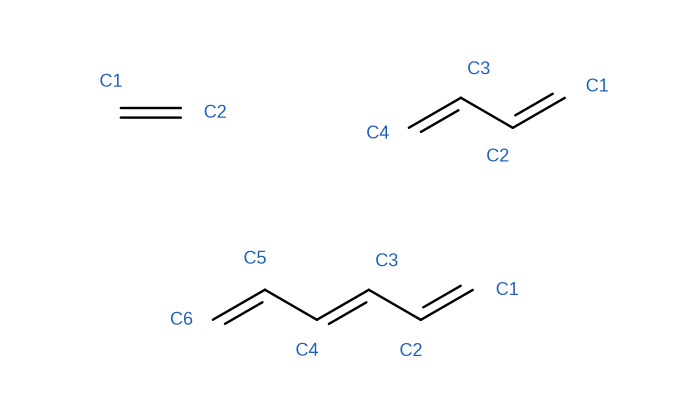
Each added double bond pushes the wavelength a molecule absorbs a few tens of nanometres further out. What is moving, and why does a longer chain absorb longer waves?
A π bond comes with an empty partner
When two p orbitals overlap, they form a bonding π orbital and an antibonding π* orbital. In the ground state the electrons sit in π. The highest filled orbital is called the HOMO (highest occupied molecular orbital); the lowest empty one, usually a π*, is the LUMO (lowest unoccupied molecular orbital). If a photon has exactly the energy of the gap between them, the molecule can swallow it and lift one electron from HOMO to LUMO: a π → π* transition. This is not a curved-arrow step. Nobody pushes the electron: the light does, in one jump.
What a longer chain does to the levels
Figure 2 draws the π levels of the three molecules of Figure 1. The levels come from the simplest model of conjugated π systems, Hückel theory: n p orbitals in a row combine into n π orbitals, and the energy of orbital is , with and constants ( is negative). The script behind the drawing computes them, and the diagram is to scale in these units. The simple model exaggerates the sizes, but it gets the trend right.
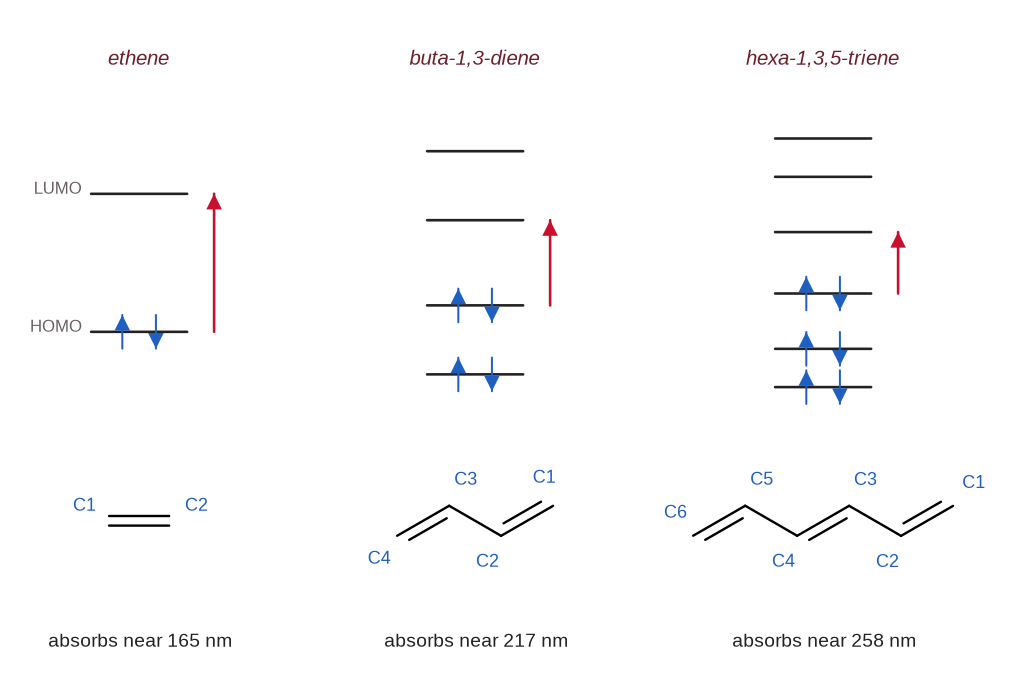
Look at the red arrows. Every extra double bond adds one occupied and one empty level, and all the levels have to fit inside the same energy band (at most ), so each added level packs them closer together: the HOMO rises and the LUMO falls. The gap shrinks, in the simple model from 2.00 units for ethene to 1.24 for the diene and 0.89 for the triene. A smaller gap means a lower photon energy, and a lower photon energy means a longer wavelength.
From a gap to a wavelength: the calculation
A photon carries , so the wavelength that fits a gap is . The gap is usually quoted per mole, and one photon lifts a single electron, so must be per electron: divide the molar gap by Avogadro's number, which is the same as multiplying hc by :
For 600 kJ/mol the same calculation gives 199 nm. So a π → π* gap of 500 to 600 kJ/mol absorbs between about 199 and 239 nm, in the ultraviolet, where our eyes see nothing. Turn it around and use the measured wavelengths of Figure 2 to read off the gaps: is about 119 600 kJ nm/mol divided by λ, so
- ethene at about 165 nm: roughly 725 kJ/mol;
- buta-1,3-diene at about 217 nm: roughly 551 kJ/mol;
- hexa-1,3,5-triene at about 258 nm: roughly 464 kJ/mol.
The gap falls with every double bond added, exactly as the levels in Figure 2 say.
From ultraviolet to colour
Each additional double bond in the chain shifts the absorption by roughly 30 to 50 nm to longer wavelength. Keep adding and the absorption crawls out of the ultraviolet and into the visible, which runs from about 400 to 700 nm. A molecule that swallows blue light looks orange, because what is left in the white light is what it did not absorb. That is why coloured organic molecules, dyes and pigments are practically all long conjugated systems. Double bonds kept apart by sp³ carbons do not add up either: only the length of the unbroken chain counts.
Longer conjugation, longer wavelength. More p orbitals in one π system means a smaller HOMO–LUMO gap, a smaller photon energy and a longer absorbed wavelength: about 165 nm for one C=C, 217 nm for two conjugated, 258 nm for three, and into the visible for a long chain.
What a microwave oven cannot do
For contrast, take a microwave photon of 2500 MHz. The energy per mole is
That is half a million times smaller than a π → π* gap. A microwave photon cannot lift an electron and cannot break a bond. It is only strong enough to change the way a molecule rotates, and in liquid water that rotational jostling is what ends up as heat in a microwave oven.
More from Structure
Why are conjugated dienes more stable than isolated ones?
Two double bonds can sit apart, side by side or share a carbon. Hydrogenation heats show which arrangement wins, and π orbitals show why.
How do you draw resonance structures? The rules and the curved arrows
When one Lewis structure is not enough: how to push electrons with curved arrows, which rules a resonance form must obey, and which form counts most.
Why is an amide flat? The C–N bond that will not turn
An amine nitrogen is a pyramid and spins freely. An amide nitrogen is flat and locked. One pair of curved arrows explains the difference.
How many π electrons does this ring have? Hückel's rule
Count the π electrons, check the ring is flat, spot the sp³ carbon. Hückel's 4n + 2 rule, tried on seven rings and counted carbon by carbon.