
 PossieChem
Primary, secondary, tertiary: why amines and alcohols count differently
A tertiary alcohol has three carbons around the carbon, a tertiary amine three around the nitrogen. Why the two are counted at different atoms, and why it matters.
- What an alcohol and an amine are
- Lewis structures and lone pairs
Alcohols and amines both come in three grades, primary, secondary and tertiary, and the words sound the same. They are not counted the same way, and treating them as the same count is a very common slip.
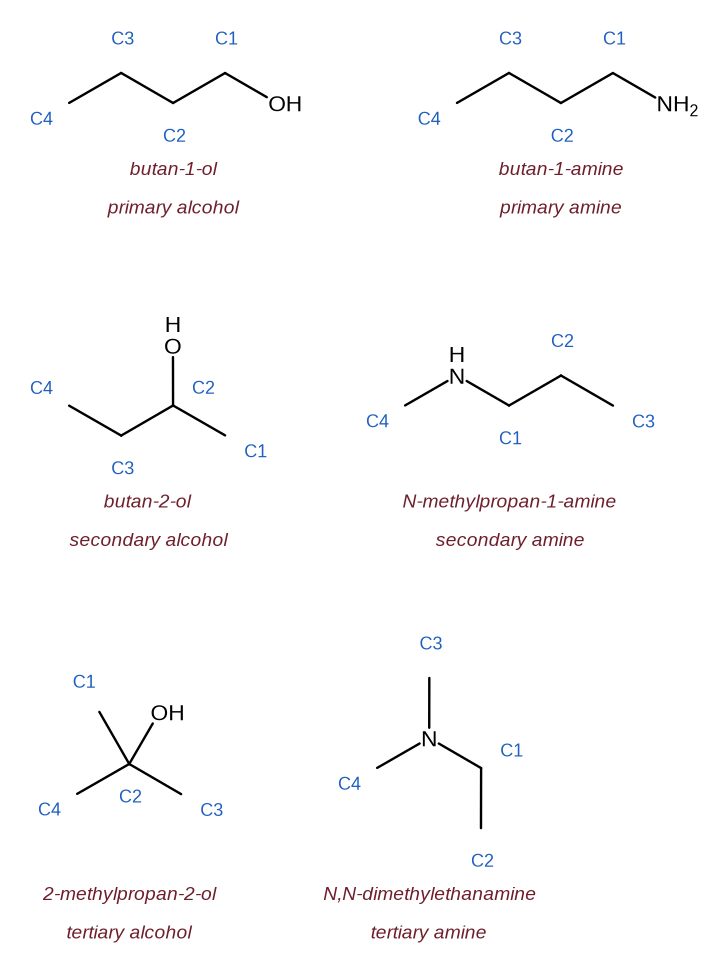
Figure 1 shows the whole thing at a glance: six molecules, three alcohols on the left and three amines on the right, each row with one more carbon group around the atom that counts. The grade is a count of carbons: one for primary, two for secondary, three for tertiary. The two families, though, do not count around the same atom.
So far the rule is easy to state, and easy to get wrong. One molecule is enough to show the trap: take the tertiary alcohol in the bottom left, swap its OH for an NH₂, and see what grade you have now.
The alcohol rule: count the carbons on the carbon
An alcohol is graded by the carbon that carries the OH, and the grade is the number of other carbon atoms attached to that carbon. In butan-1-ol the carbon with the OH is C1, and it has one carbon neighbour (C2): primary. In butan-2-ol the carbon with the OH is C2, and it has two (C1 and C3): secondary. In 2-methylpropan-2-ol the carbon with the OH is C2, and it has three (C1, C3 and C4): tertiary.
The amine rule: count the carbons on the nitrogen
An amine is graded by the nitrogen, and the grade is the number of carbon groups bonded to it. Butan-1-amine has one carbon on the nitrogen (C1): primary. N-Methylpropan-1-amine has two (C1 and the N-methyl carbon C4): secondary. N,N-Dimethylethanamine has three (C1, C3 and C4): tertiary.
The reason they differ is simple. What matters for an alcohol is the carbon, because that is where the interesting chemistry happens (the next section shows it). What matters for an amine is the nitrogen, because the lone pair on nitrogen does the work, and the number of carbon groups decides how crowded it is and how many N–H bonds are left.
The trap: a tertiary alcohol and a primary amine
Figure 2 puts the two rules side by side on the same carbon skeleton.
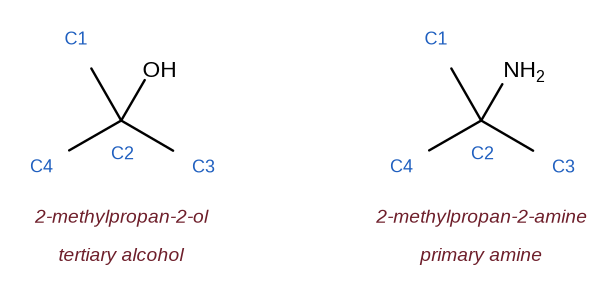
In 2-methylpropan-2-ol the carbon with the OH (C2) has three other carbons: tertiary. In 2-methylpropan-2-amine the carbon with the NH₂ is the same C2, and still has three carbons around it. But the grade of an amine is read off the nitrogen, and the nitrogen is bonded to only one carbon: primary. However branched the carbon group is, one carbon group on the nitrogen is a primary amine.
What the grade changes: the alcohol that loses water
For alcohols the grade predicts how easily the carbon can become a cation. Figure 3 shows the tertiary one in acid, every arrow on the real molecule.
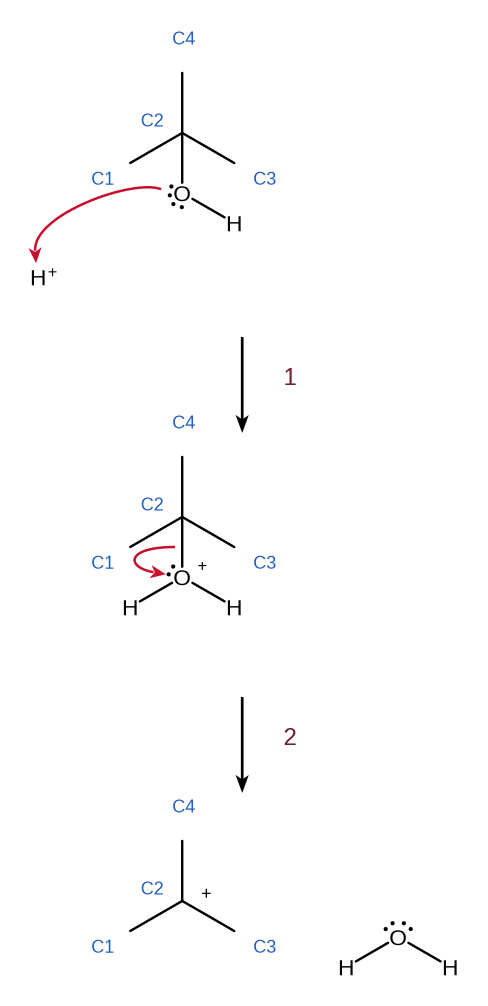
Step 1: protonation. A lone pair on the oxygen takes H⁺ (first arrow). The oxygen has three bonds now, a positive charge, and it is a much better leaving group than OH⁻ ever was, because it will leave as neutral water.
Step 2: water leaves. The C2–O bond breaks and its two electrons go onto the oxygen (arrow). Water departs and C2, left with only three bonds, carries the positive charge. C2 has three carbon neighbours, and each carbon group helps to carry the charge a little. That is why the cation, and therefore the whole route, is easy for a tertiary alcohol.
Run the same two steps on butan-1-ol and the carbon that would carry the charge is C1, which has only one carbon neighbour: a primary cation, far less stable, so the step is slow to the point of not happening under the same mild conditions (the primary alcohol has a different route, in which something attacks C1 as water leaves). The grade is a prediction: the more carbons on the carbon bearing the OH, the more willingly the oxygen leaves. From here the cation either captures a nucleophile again or loses a proton from a neighbouring carbon to give an alkene.
What the grade changes in an amine
For an amine the grade is about the nitrogen's neighbours, and the effects show up there. A primary amine has two N–H bonds, a secondary amine one, and a tertiary amine none. N–H bonds are what an amine uses to donate hydrogen bonds to its neighbours, so the boiling points of these isomers fall as the grade rises: butan-1-amine boils at about 78 °C and N,N-dimethylethanamine, with no N–H at all, at about 37 °C. (For comparison, the four-carbon alcohols run from 118 °C for butan-1-ol, through 99 °C for butan-2-ol, to 82 °C for 2-methylpropan-2-ol.) And a crowded nitrogen is a more hindered one: the lone pair is still there, but three carbon groups around it get in the way of anything that wants to approach.
Count around the atom that does the chemistry. Alcohol: count the carbons on the carbon that carries the OH (one, two, three: primary, secondary, tertiary). Amine: count the carbon groups on the nitrogen itself. So 2-methylpropan-2-ol is a tertiary alcohol and 2-methylpropan-2-amine, on the very same carbon skeleton, is a primary amine.
More from Structure
Alkane, alkene, alkyne or arene? The four hydrocarbon families
Four families, made of nothing but carbon and hydrogen. One count, the hydrogens, tells saturated from unsaturated, and the double bond shows why it matters.
Alcohol, ether or acetal? Oxygen with only single bonds
One oxygen, three personalities. How to tell an alcohol, an ether and an acetal apart, and why the second oxygen of an acetal changes everything.
Which functional group wins the name? IUPAC priority, explained
A molecule with an acid, an alcohol and a ketone gets only one kind of suffix. The priority list decides who gets it: five molecules worked out.
Aldehyde, ketone, acid, ester, anhydride, acid chloride: the carbonyl family
The C=O group is the busiest address in organic chemistry. Six families sit on it, three of them are the carboxylic acid with its OH swapped for something else.