
 PossieChem
Thiol, disulfide, sulfonic acid, phosphine, phosphate: sulfur and phosphorus
Sulfur plays the same game as oxygen with heavier pieces, and phosphorus adds a few of its own. Seven functional groups, what each is made of, and the swap that links the sulfur ones.
- What an alcohol and an ether are
- Lewis structures
- Lone pairs and curved arrows
Sulfur sits right below oxygen in the periodic table, so it can play the same game: wherever oxygen makes an alcohol, an ether or an O–O link, sulfur can make a thiol, a thioether or a disulfide. The molecules look the same on paper, with an S where the O used to be. Underneath they are not twins: sulfur is bigger, softer and a much more flexible partner.
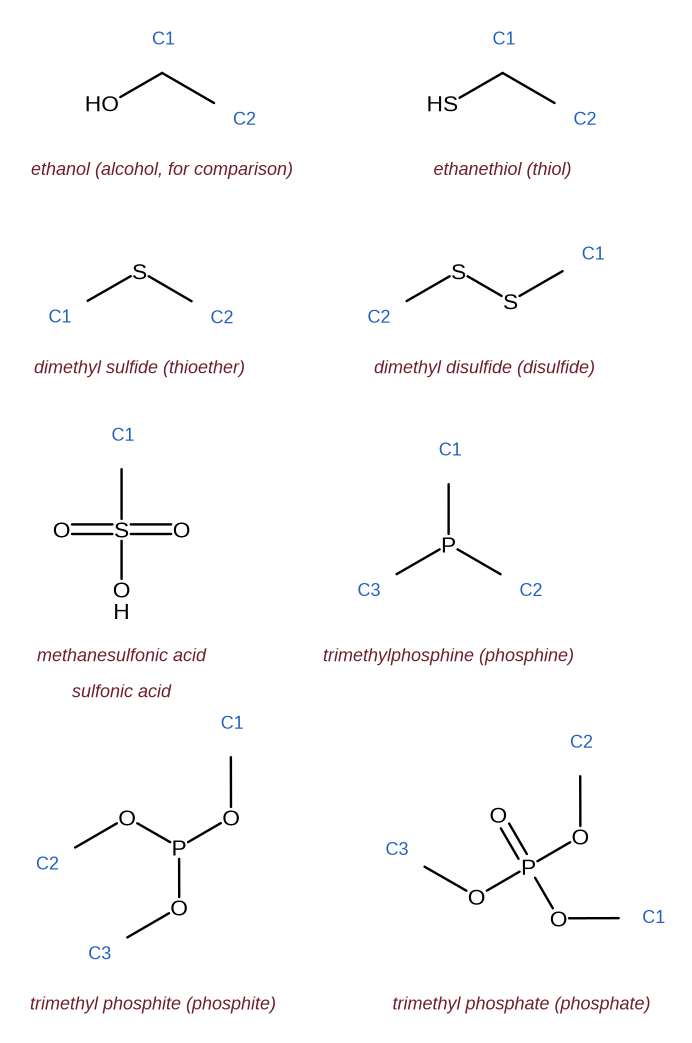
Phosphorus, one column to the left of sulfur, is the other heavyweight of biochemistry. It gives phosphines, with three carbon groups on P, phosphites, with three O–C groups, and phosphates, which are phosphites with an extra P=O. Figure 1 shows one small example of each, with ethanol added for comparison, and a seventh family, the sulfonic acids, in which a sulfur carries two S=O bonds and an OH.
Seven families is a lot to hold in your head at once, but they fall into three stories: what happens when you swap O for S, what a sulfur with two S=O bonds and an OH is, and what happens when you put a P in the middle of three groups. We take the sulfur story first, because the last member of that family, the disulfide, is one of the few functional groups that a reaction can build and break again and again.
Thiol, thioether, disulfide: oxygen with a heavier sibling
A thiol is the sulfur version of an alcohol: an SH on a carbon (an older name is mercaptan). In ethanethiol the SH sits on C1. A thioether is the sulfur version of an ether, a sulfur between two carbons, as in dimethyl sulfide with C1 and C2 on either side. A disulfide has two sulfurs bonded to each other, between two carbons, as in dimethyl disulfide.
The swap from O to S changes the behaviour in three ways you can predict from the periodic table.
A thiol is a much poorer hydrogen-bond donor than an alcohol, because sulfur is larger and less electronegative than oxygen. Ethanethiol boils at about 35 °C, against 78 °C for ethanol, which has almost the same shape. A thiol is also much more acidic: the pKa of ethanethiol is about 10.6, and ethanol's is about 16, a difference of five or six pKa units. A big sulfur atom spreads out the negative charge of its conjugate base, the thiolate, over a larger volume, and the S–H bond is also weaker than O–H. And thiols smell: ethanethiol is detectable by the human nose at very low concentrations, which is why thiols such as ethanethiol are added to natural gas to give it its warning smell.
The disulfide link, S–S, is a relatively weak bond (much weaker than a C–C or C–O bond), and that is what makes it useful. Proteins use disulfide bridges between two side-chain thiols as removable staples.
How two thiols trade a disulfide
A thiolate and a disulfide can swap partners. This thiol–disulfide exchange is how cells make and break disulfide bridges. Figure 2 shows it on the real molecules: ethanethiolate (carbons C1 and C2) attacks dimethyl disulfide (carbons C3 and C4).
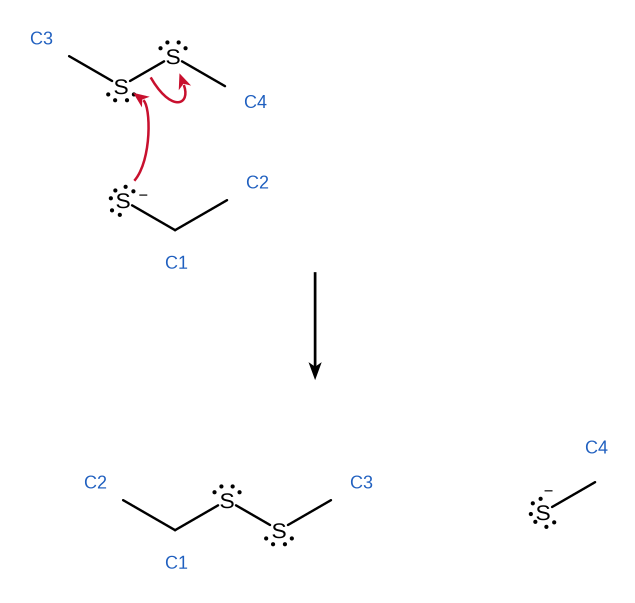
One step, two arrows. A lone pair on the negatively charged sulfur of ethanethiolate attacks the nearer sulfur of dimethyl disulfide (first arrow). That sulfur cannot keep two S–S bonds, so the old S–S bond breaks and its electron pair goes onto the other sulfur (second arrow), which leaves as methanethiolate. The new bond joins the ethyl group to the methyl group through S–S: ethyl methyl disulfide. The negative charge has moved from one sulfur to the other, nothing else has changed, and every sulfur keeps a full octet. It is the same kind of displacement you will meet later on carbon (the SN2 reaction), only here the atom that is attacked is sulfur, and the leaving group is a thiolate.
Because thiolate leaving and thiolate attacking are the same kind of species, the reaction runs in both directions and settles at an equilibrium. It is also much faster when thiolate is around, which is why it speeds up as the pH approaches and passes the thiol's pKa of about 10.6.
The sulfonic acid: sulfur with two S=O bonds
A sulfonic acid has a sulfur bonded to a carbon, to an OH, and to two oxygens by S=O bonds, as in methanesulfonic acid (C1 is the carbon on sulfur). Unlike oxygen and nitrogen, sulfur and phosphorus come from the third row of the periodic table and are normally drawn with more than eight electrons around them, so S=O and P=O double bonds are written without charges. (The modern bonding picture is closer to a very polar single bond, but the double-bond drawing is the standard convention.)
Sulfonic acids are strong acids: the pKa of methanesulfonic acid is about −2, while carboxylic acids sit around 4 to 5. Sulfonic acids rank right after carboxylic acids in the naming priority list.
Phosphine, phosphite, phosphate: three groups on P
In the phosphorus families the phosphorus carries three groups in the first two cases and four in the third. A phosphine has three carbon groups on P (trimethylphosphine: C1, C2 and C3 on the phosphorus), and like an amine it keeps a lone pair, so it is pyramidal and a good nucleophile. A phosphite has three O–C groups on P (trimethyl phosphite; C1 to C3 are the carbons on the three oxygens) and, like the phosphine, keeps a lone pair on phosphorus. A phosphate is the phosphite with an extra P=O (trimethyl phosphate): the lone pair has been used to make that double bond, and the phosphorus now has four groups around it, in a tetrahedron.
Going from phosphite to phosphate is an oxidation, from phosphorus(III) to phosphorus(V), which is why phosphites are easily turned into phosphates. The phosphate is the one that carries biology: the backbone of DNA and RNA and the cell's energy-carrying molecules are built on phosphate links.
Swap O for S, put P in the middle. Thiol (SH on a carbon), thioether (S between two carbons), disulfide (S–S between two carbons): sulfur versions of an alcohol, an ether and an O–O link, with a poorer hydrogen bond, a lower pKa, and a weak S–S bond that thiolates break and make. Sulfonic acid: sulfur with two S=O and an OH, a strong acid. Phosphine: P with three carbons. Phosphite: P with three O–C groups. Phosphate: the phosphite with an extra P=O.
More from Structure
Alkane, alkene, alkyne or arene? The four hydrocarbon families
Four families, made of nothing but carbon and hydrogen. One count, the hydrogens, tells saturated from unsaturated, and the double bond shows why it matters.
Alcohol, ether or acetal? Oxygen with only single bonds
One oxygen, three personalities. How to tell an alcohol, an ether and an acetal apart, and why the second oxygen of an acetal changes everything.
Which functional group wins the name? IUPAC priority, explained
A molecule with an acid, an alcohol and a ketone gets only one kind of suffix. The priority list decides who gets it: five molecules worked out.
Aldehyde, ketone, acid, ester, anhydride, acid chloride: the carbonyl family
The C=O group is the busiest address in organic chemistry. Six families sit on it, three of them are the carboxylic acid with its OH swapped for something else.