
 PossieChem
Why is the C–H next to a carbonyl acidic? The enolate, step by step
A normal C–H has a pKa around 50. Put a C=O next to it and the pKa drops to 20, thirty units, from one neighbour. The enolate shows how.
- What a pKa means (a small pKa is a strong acid)
- Resonance and curly arrows
- What a C=O bond looks like
An ordinary C–H bond hardly gives up its proton at all: the pKa is about 50, and that is a number you can only reach with the strongest bases chemists own. Now look at acetone in Figure 1. The three hydrogens on C3, the carbon next to the carbonyl carbon C2, have a pKa of about 20. That is thirty units, a factor of , from the neighbour alone, and the hydrogens on C1, the other CH₃ of the molecule, are exactly the same: C1 and C3 are mirror images.
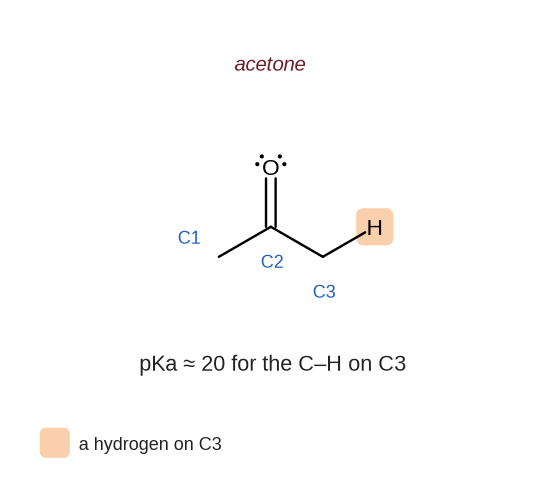
A C–H that loses a proton leaves its two electrons behind on carbon, so something about the C=O next door must be taking care of that pair. What is it?
Step 1: a base takes the proton of C3
Figure 2 uses hydroxide as the base. Arrow 1: a lone pair on the oxygen of hydroxide forms a bond to the orange hydrogen. Arrow 2: the C3–H bond breaks, but its electrons do not stay on C3. They move into the bond between C3 and C2 and make it a double bond. Arrow 3: to make room, the C=O π bond moves onto the oxygen as a lone pair. Three arrows, and the result is an enolate: a C2=C3 double bond with the negative charge on the oxygen.
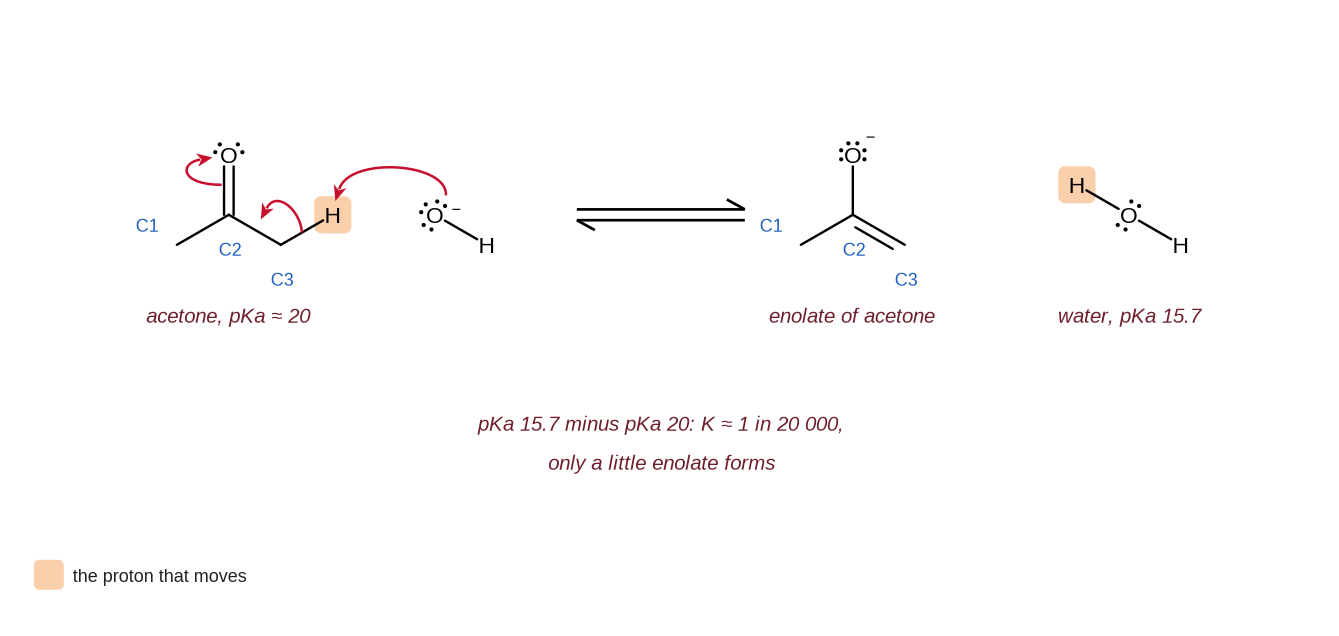
Water is the stronger acid (15.7 against about 20), so hydroxide makes only a little enolate: , which for equal starting amounts is under 1% converted. A small amount is already enough for many reactions of carbonyl compounds, and a bigger one needs a stronger base.
Step 2: where does the charge sit?
The charge on the oxygen is only one way of drawing the enolate. Figure 3 shows another. Arrow 1: a lone pair of the oxygen forms the C2=O double bond again. Arrow 2: the C2=C3 π bond moves to C3 and becomes a lone pair. The charge is now on carbon.
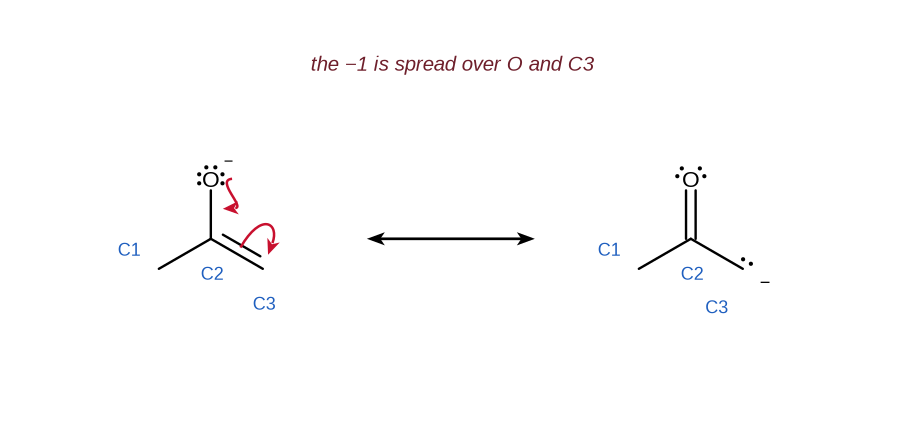
The real ion has the −1 shared by oxygen and C3, with the larger part on the oxygen, which is the more electronegative of the two. That is how the carbonyl takes care of the electron pair: the carbon that loses the proton is next to a π system, and the pair can slide into it. A hydrogen on an ordinary sp³ carbon has nowhere to send its pair, and that is the main difference between 20 and 50.
Key idea. A C–H next to a C=O is acidic because its conjugate base, the enolate, is stabilised by resonance: the charge is shared with the carbonyl oxygen. A pKa of about 20 is the price, against about 50 for an isolated C–H.
Step 3: two carbonyls at once
If the carbon sits between two C=O groups, the charge has two oxygens to go to, and the acid is far stronger. Figure 4 shows pentane-2,4-dione, whose C3 sits between the carbonyl carbons C2 and C4. Its pKa is about 9. The three arrows are the same as in Figure 2: hydroxide takes the hydrogen of C3, the electrons form the C2=C3 bond, and the C2=O bond goes onto its oxygen.
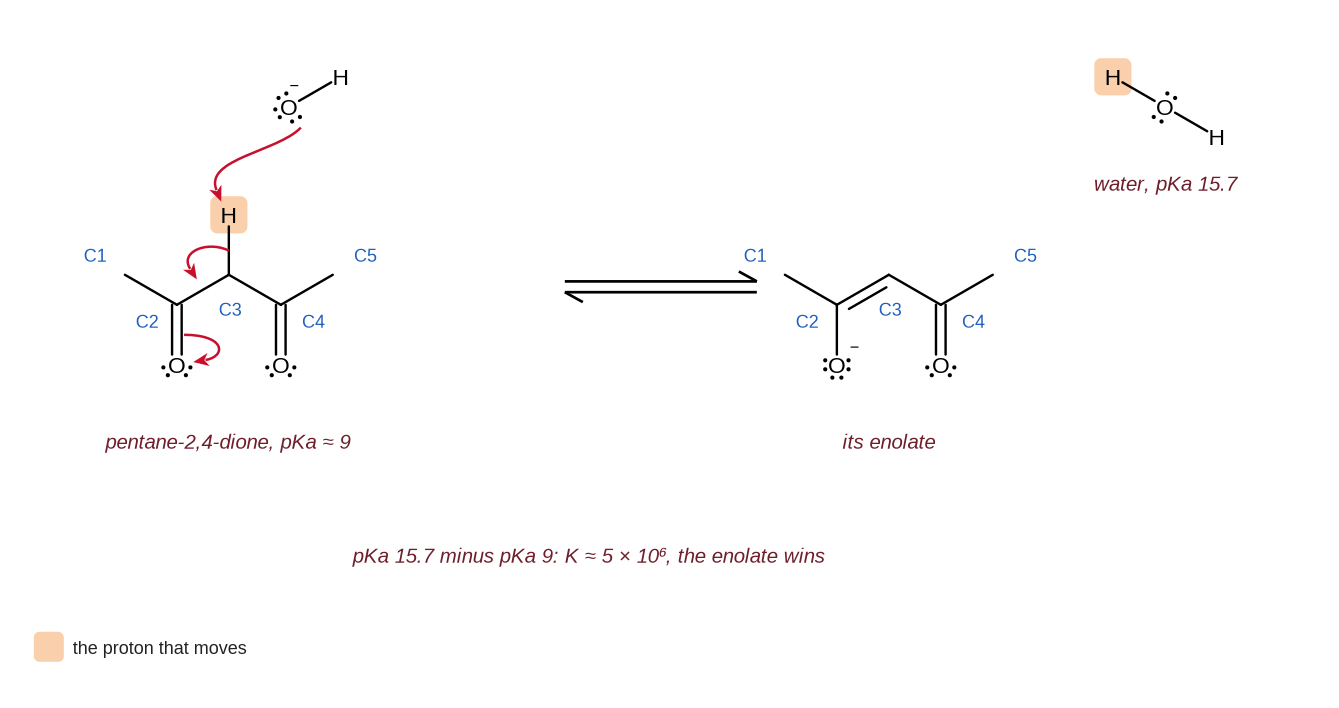
: the enolate is favoured about five million to one, and ordinary hydroxide or alkoxide bases turn the whole sample into the enolate. Figure 5 follows the charge in this ion. The first form has it on the oxygen of C2, the second on C3, the third on the oxygen of C4: three atoms share the −1, two of them oxygens.
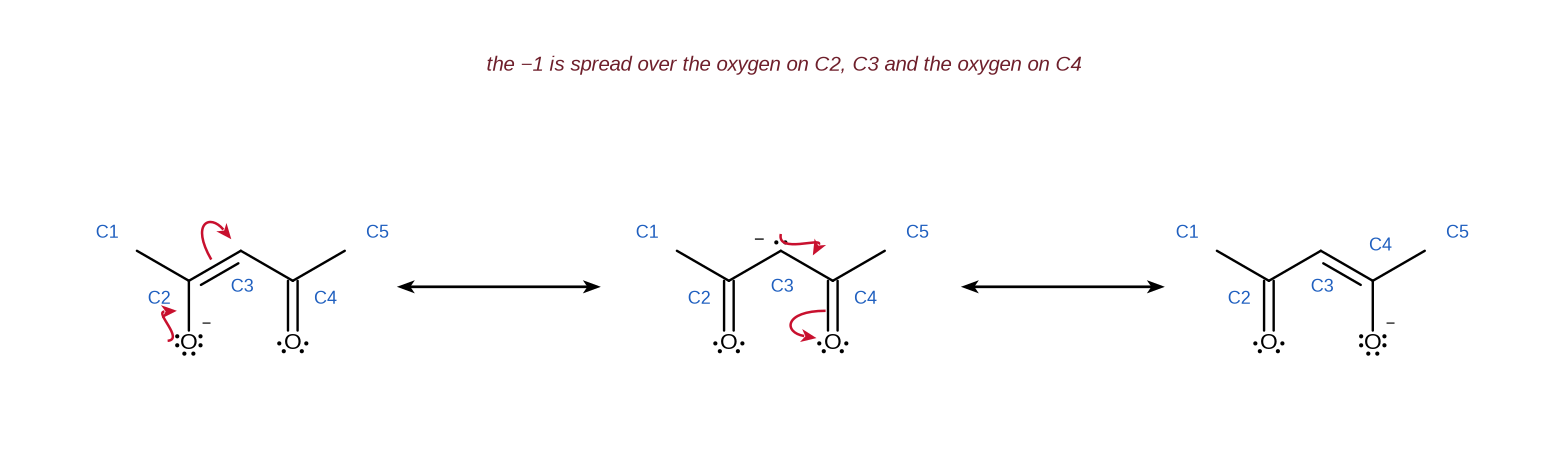
Watch out. Normally only the hydrogens on the carbon directly bonded to the carbonyl carbon are acidic, because only there can the pair slide into the C=O. In pentane-2,4-dione the CH₃ hydrogens on C1 and C5 are also next to a carbonyl, and acidic in the acetone way (about 20), but C3 sits between two, and that is where the 9 comes from. A C–H one carbon further away is an ordinary C–H again, unless a C=C carries the pair on to the carbonyl.
More from Structure
What does a pKa tell you? Acid strength from one number
One small number says how hard an acid pushes its proton away, and with it you can tell which hydrogen in a molecule leaves first. Here is how to read it.
Which way does an acid–base reaction go? Predict it with pKa
Put phenol and pyridine in a flask and ask which way the proton moves. One subtraction of two pKa values gives the direction and how far it goes.
Why is acetic acid so much more acidic than ethanol?
Both lose a proton from an O–H bond, yet acetic acid is about a hundred billion times more acidic than ethanol. The reason is where the leftover charge can sit.
Why is HI a stronger acid than HF, though F is more electronegative?
Fluorine pulls electrons harder than iodine, so H–F should be the strongest of the hydrogen halides. It is the weakest. The trend turns around when you go down a group.