
 PossieChem
LDA, NaH and butyllithium: how strong a base do you need?
How strong a base do you need? LDA, NaH and butyllithium, and what the pKa of the acid each one gives tells you about them.
- What a pKa means (a small pKa is a strong acid)
- Predicting an acid–base equilibrium from two pKa values
- Enolate formation
A base is as strong as its conjugate acid is weak. The way to say that in numbers: the pKa of the acid that forms when the base takes a proton. A high number means a strong base, and the number tells you what the base can still deprotonate. Hydroxide, whose conjugate acid is water at 15.7, can take a proton from a simple ketone (pKa about 20) only to a small extent. If you want all of the ketone to react, you need a base whose conjugate acid sits well above 20, by three units or more.
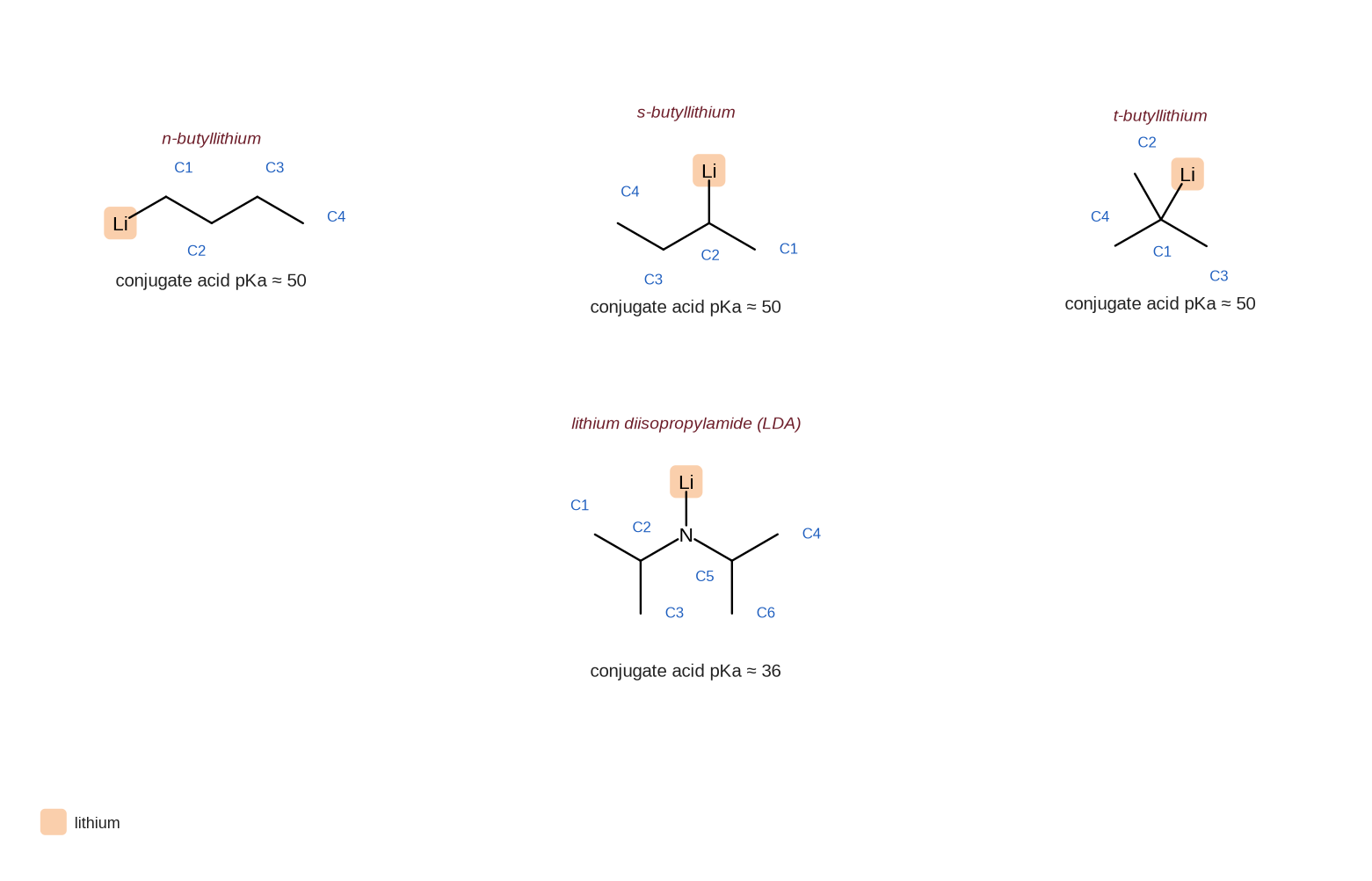
Figure 1 shows four of the bases that do that. Three are butyllithiums: n-, s- and t-butyllithium, where the lithium sits on C1, on C2 or on C1 of a branched chain. The fourth is lithium diisopropylamide, LDA, where the lithium sits on a nitrogen between two isopropyl groups. The number under each is the pKa of the acid that forms when it takes a proton.
Between 36 and 50 lies a gap of fourteen units. What does that buy, and why would you ever choose the weaker of the two?
Step 1: LDA deprotonates acetone, completely
Figure 2 is the enolate reaction of the acidic C–H page, with LDA in place of hydroxide. Arrow 1: the lone pair of the diisopropylamide nitrogen forms a bond to a hydrogen on C3 of acetone. Arrow 2: the C3–H bond moves into the C2–C3 bond. Arrow 3: the C=O π bond moves onto the oxygen. The lithium ion is not drawn: it stays with the oxygen of the enolate (in reality it also sits next to the carbonyl oxygen), but it does not change the arrows.
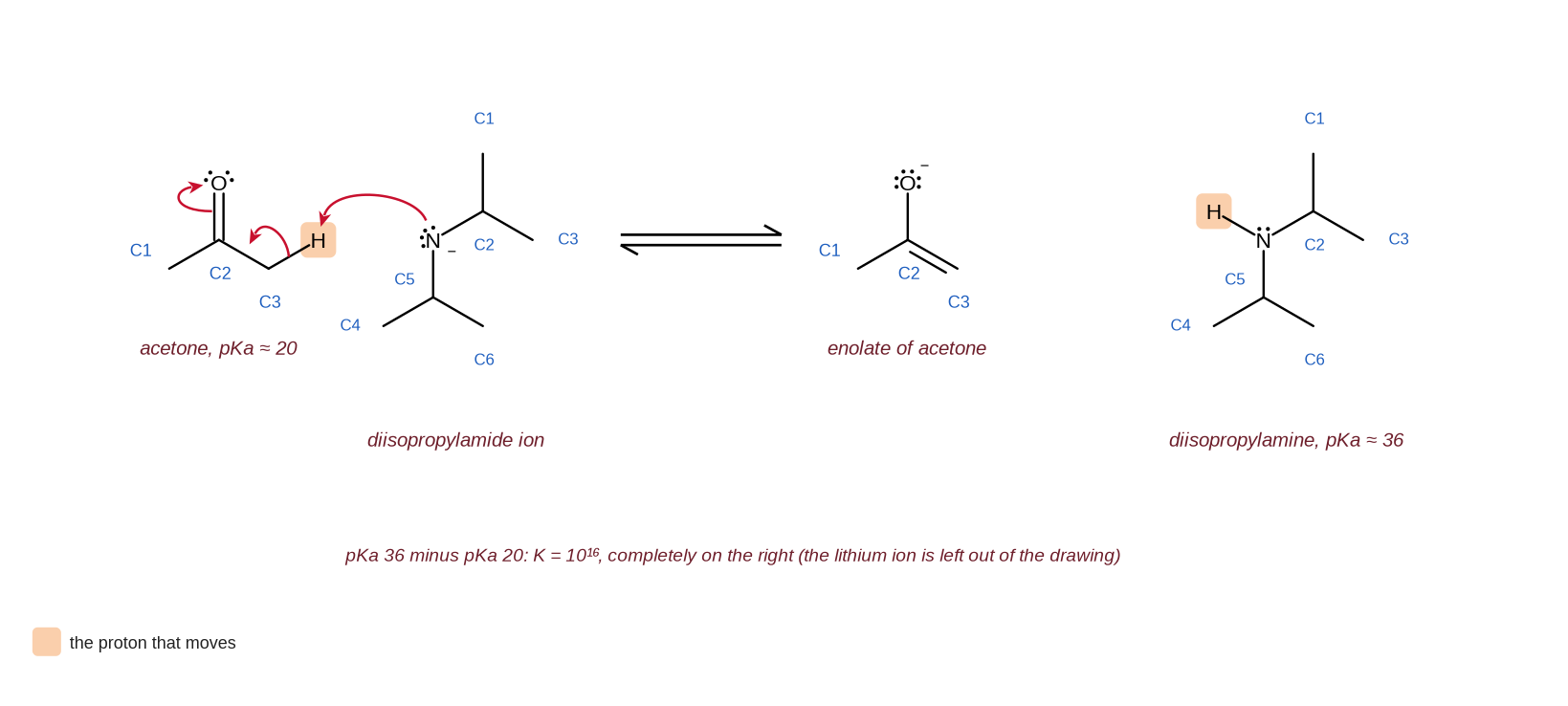
The subtraction: . Every acetone molecule is converted; nothing is left to react with the enolate that is formed. That is the difference between a trace of enolate and all of it. LDA also has two bulky isopropyl groups around the nitrogen, so it is a poor nucleophile: it is too crowded to attack the carbonyl carbon and it takes the small, exposed proton instead.
Step 2: NaH, and the gas that does not come back
Sodium hydride works differently. The base is the hydride ion H⁻, a lone pair on a bare hydrogen, and its conjugate acid is H₂ with a pKa of about 36. Figure 3 uses ethanol as the acid. Arrow 1: the lone pair of the hydride ion forms a bond to the O–H hydrogen. Arrow 2: the O–H bond becomes a lone pair on oxygen. The H–H bond that has just formed is H₂, a gas.
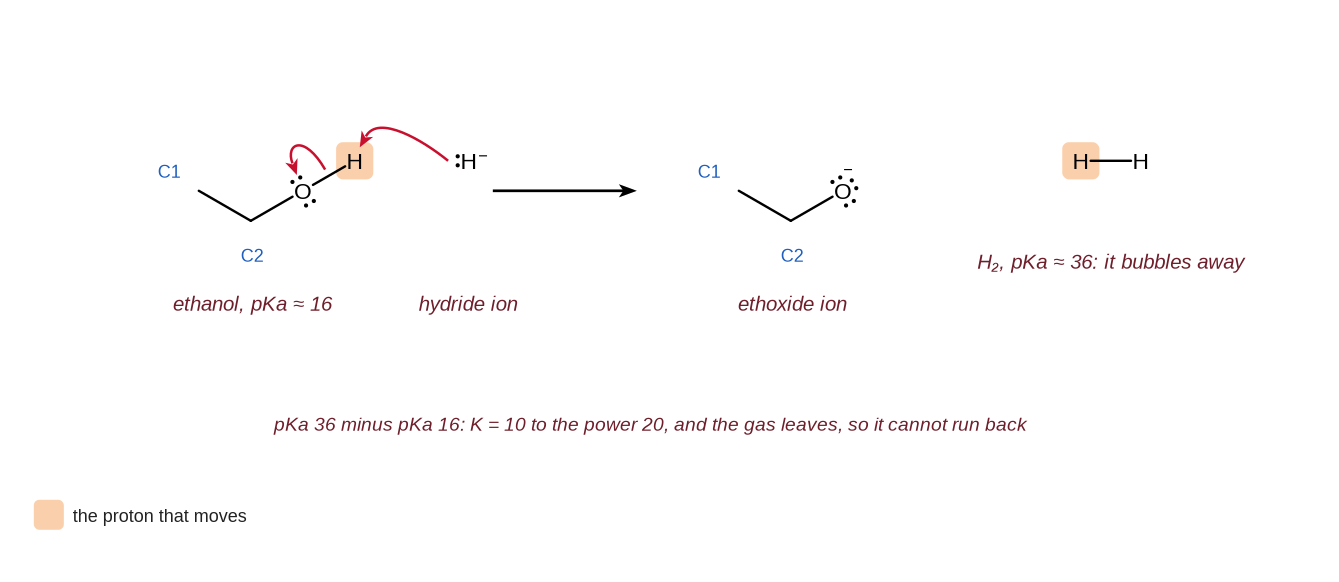
The equilibrium constant is already huge, , and because the H₂ escapes as a gas the reaction cannot even run backwards. You see it happen as bubbles. This is why NaH is so popular for alcohols and for carbonyl compounds, and why nothing is left behind except the sodium salt.
Step 3: organolithiums, the strongest of the lot
The lithium of an organolithium sits on a carbon, and the carbon–lithium bond is so polar that the carbon behaves almost like a carbanion. Its conjugate acid is an alkane, with a pKa of about 50: fourteen units above LDA, so a butyllithium can deprotonate things that LDA cannot touch. Figure 4 shows it for n-butyllithium and ethanol. Arrow 1: the electrons of the C1–Li bond form a new bond from C1 to the O–H hydrogen. Arrow 2: the O–H bond becomes a lone pair on oxygen. The products are butane, the ethoxide ion and a lithium ion. Organolithiums are made from an alkyl chloride and lithium metal: R–Cl + 2 Li → R–Li + LiCl.
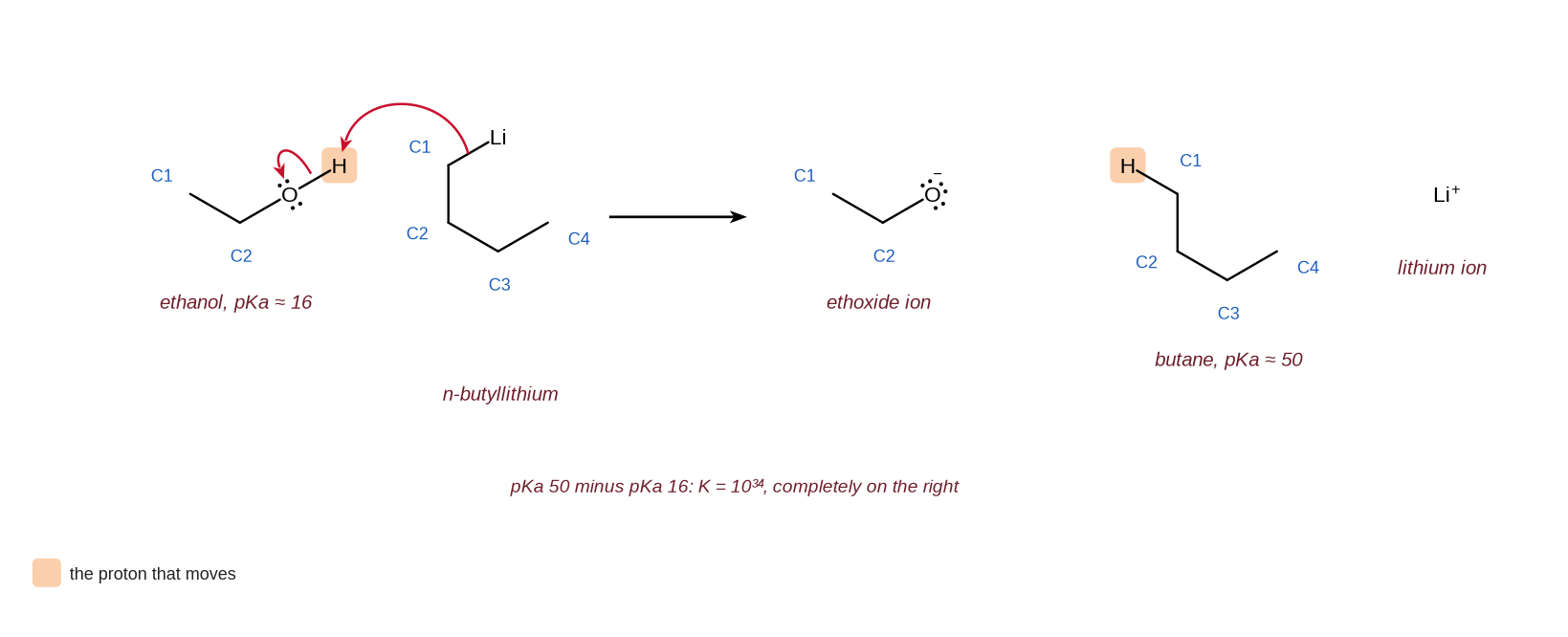
The three butyllithiums in Figure 1 differ in how the carbon that carries the lithium is substituted, and the more substituted ones are the more reactive. That also makes them more dangerous: t-butyllithium ignites on contact with air, and the others are handled with the same care.
Key idea. Choose a base whose conjugate acid has a pKa at least three units above the acid you want to deprotonate, subtract the two numbers, and you know how far it goes: acetone (20) with LDA (36) is complete; with hydroxide (15.7) it is only a trace.
Watch out. These bases are too strong for protic solvents. An organolithium reacts with anything that has an O–H, including the moisture in the air, and with a of or more, and they are used in dry ether or a dry hydrocarbon solvent under nitrogen. The same pKa values tell you which solvents these bases destroy: anything with an O–H, and even ethers if they are warm.
More from Structure
What does a pKa tell you? Acid strength from one number
One small number says how hard an acid pushes its proton away, and with it you can tell which hydrogen in a molecule leaves first. Here is how to read it.
Which way does an acid–base reaction go? Predict it with pKa
Put phenol and pyridine in a flask and ask which way the proton moves. One subtraction of two pKa values gives the direction and how far it goes.
Why is acetic acid so much more acidic than ethanol?
Both lose a proton from an O–H bond, yet acetic acid is about a hundred billion times more acidic than ethanol. The reason is where the leftover charge can sit.
Why is HI a stronger acid than HF, though F is more electronegative?
Fluorine pulls electrons harder than iodine, so H–F should be the strongest of the hydrogen halides. It is the weakest. The trend turns around when you go down a group.