
 PossieChem
Sulfonic, sulfinic and phosphonic acids: why S–OH and P–OH are so acidic
Three acids with an O–H on sulfur or phosphorus, pKa −3, 2.8 and 1.8. Why are they so far apart?
- What a pKa means (a small pKa is a strong acid)
- Resonance and curly arrows
- Lone pairs and formal charge
Three acids share one trick: the proton that leaves sits on an oxygen, and the oxygen sits on a sulfur or a phosphorus that carries other oxygens. Figure 1 shows them with a phenyl ring (or, for the first, a tolyl ring) hanging on the other side. The orange hydrogen is the one that leaves.
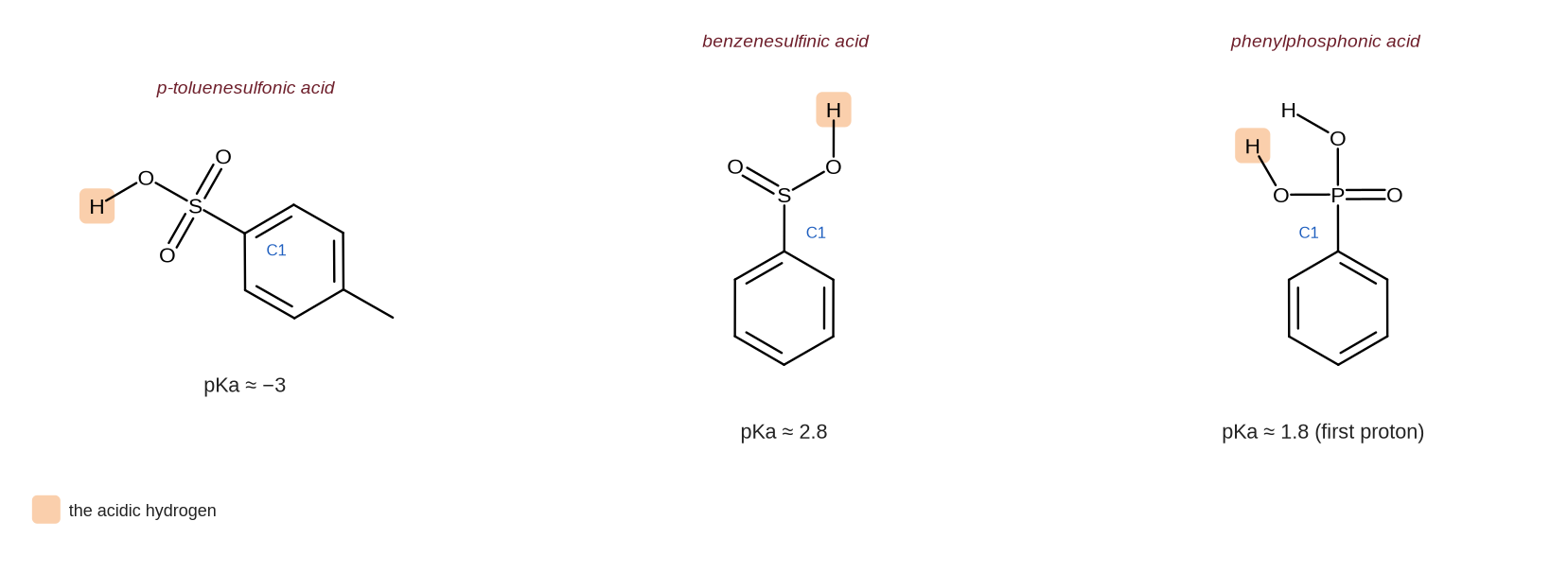
For comparison, a simple carboxylic acid sits at about 4.8. All three beat it, and the first beats it by almost eight units, a factor of nearly . The three formulas look similar. Why are they so far apart?
Step 1: the sulfonic acid hands over its proton
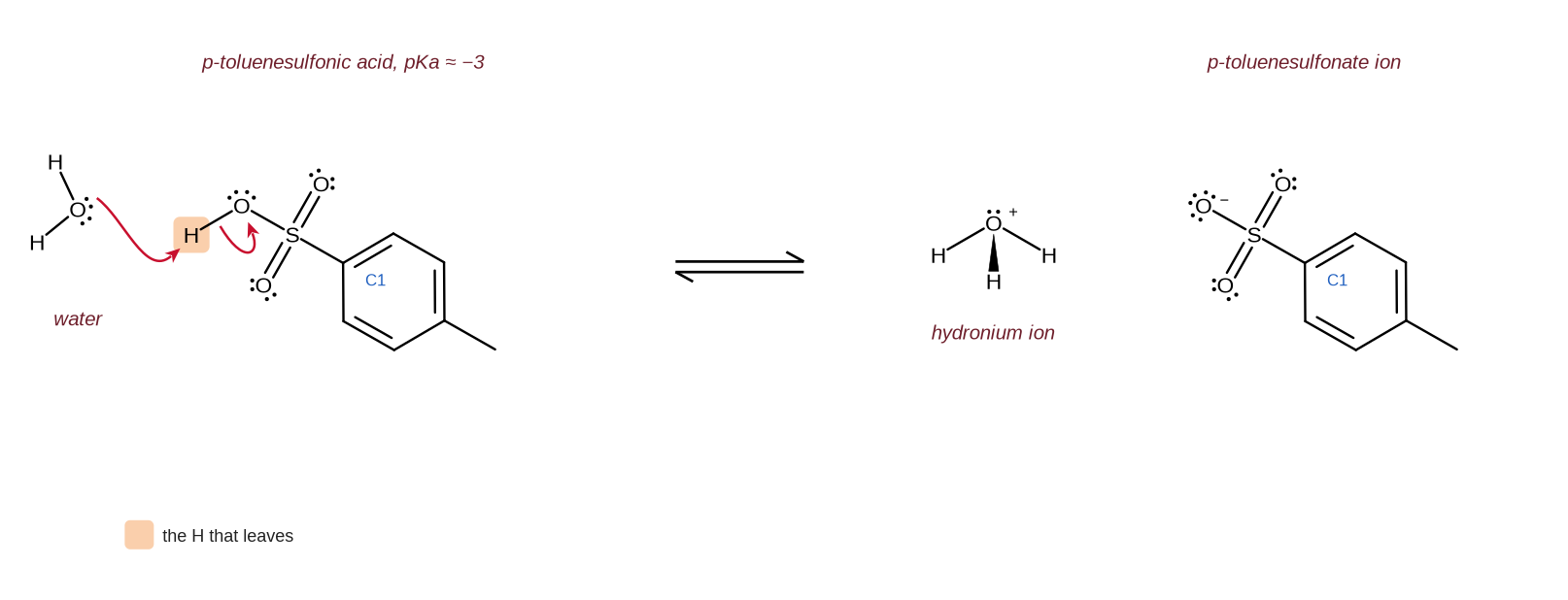
Figure 2 gives p-toluenesulfonic acid its partner. Arrow 1: a lone pair of the oxygen of water forms a bond to the hydrogen. Arrow 2: the O–H bond becomes a lone pair on the oxygen. The ions are the p-toluenesulfonate ion and the hydronium ion. With a pKa of −3 against −1.7 for hydronium, the proton goes to water, and in dilute aqueous solution the acid is fully dissociated: the subtraction gives in favour of the ions.
Step 2: three oxygens share one charge
In the p-toluenesulfonate ion the −1 sits, in the first drawing, on one oxygen. Figure 3 shows that the three oxygens are interchangeable. Arrow 1: a lone pair of the oxygen that carries the charge forms a double bond to sulfur. Arrow 2: one of the S=O π bonds moves onto its oxygen as a lone pair. The charge has moved to the other oxygen, and the same two arrows move it again to the third.
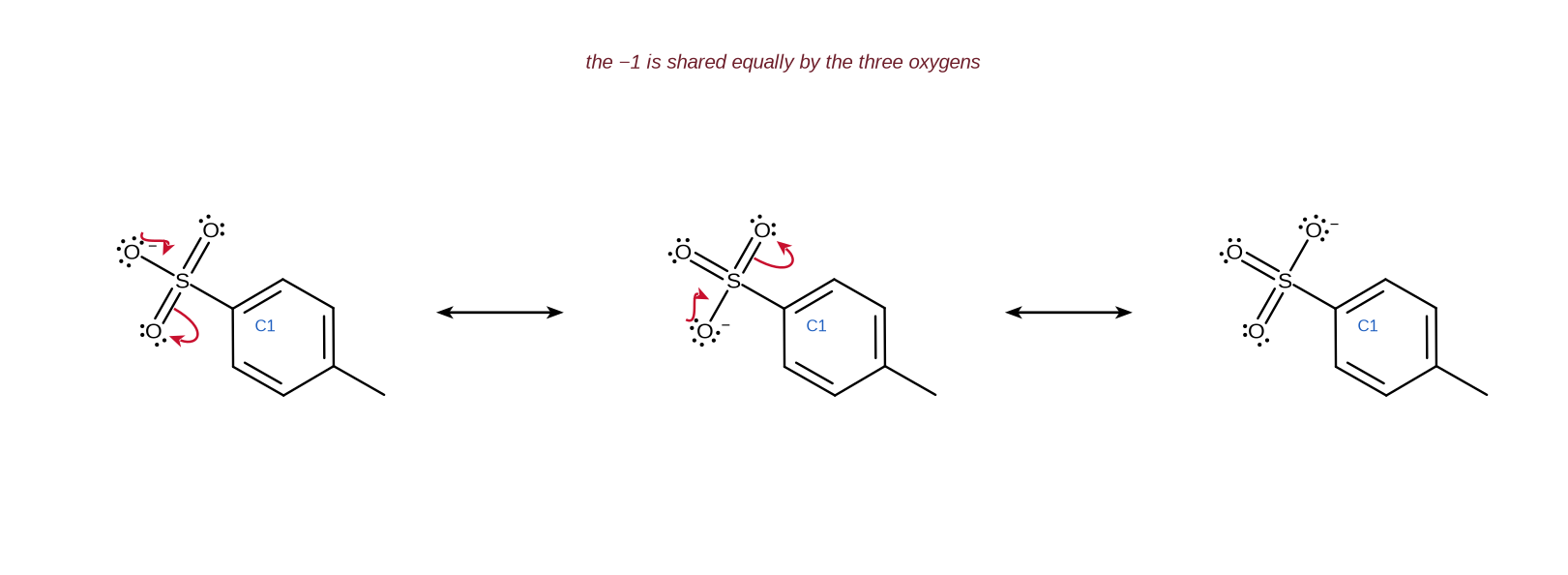
Three atoms share the charge, and the electronegative oxygens are good at holding it. That is why the sulfonic acid is strong: a conjugate base this comfortable has little reason to take the proton back. The same stability is also why tosylate is a good leaving group.
Step 3: two oxygens, and why that is weaker
Figure 4 does the same for the other two acids. In the benzenesulfinate ion (top) sulfur has only two oxygens, so only two share the charge. In the phenylphosphonate monoanion (bottom) the phosphorus has three oxygens, but one of them still carries its hydrogen, so only two are free to share. In both cases the arrows are the same pair: the lone pair of the charged oxygen forms the double bond, and the double bond of the other oxygen moves onto that oxygen.
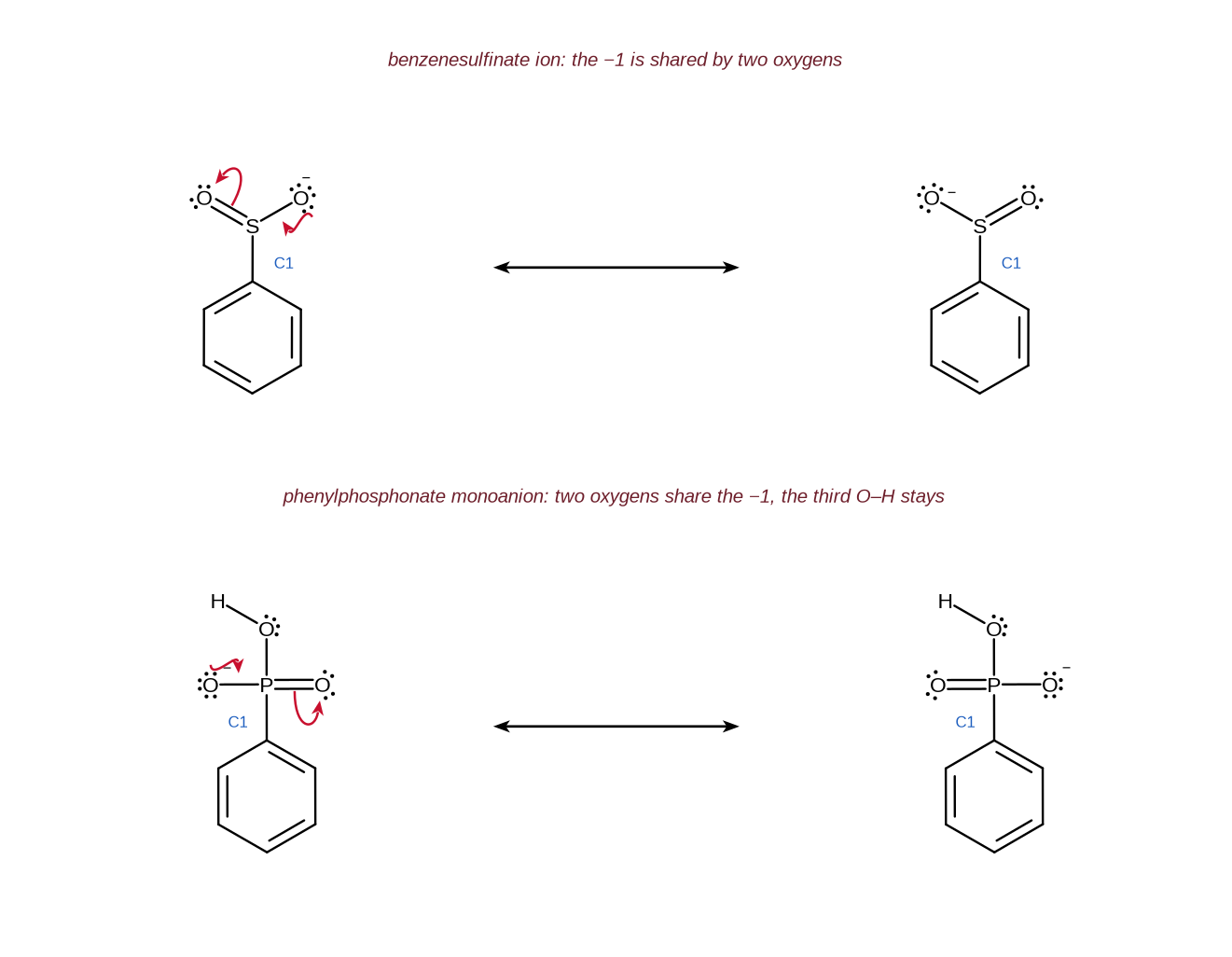
Two oxygens sharing a charge is the same arrangement as the carboxylate ion of a carboxylic acid, and it gives pKa values in the same region: 2.8 for the sulfinic acid and 1.8 for the first proton of the phosphonic acid, both below the 4.8 of a simple carboxylic acid. The small differences between 1.8, 2.8 and 4.8 come from the central atom and what else is on it, not from the oxygen count, which is two in all three. The sulfonic acid, with three oxygens and a sulfur in a higher oxidation state, goes another five to six units down. The second proton of the phosphonic acid is much harder to remove: it has to leave an ion that is already negative.
Key idea. Count the oxygens that can share the charge of the conjugate base. Three (sulfonate, pKa −3) beats two (sulfinate 2.8, phosphonate 1.8, carboxylate about 4.8).
Watch out. The pKa that is quoted for a phosphonic acid is its first one. The monoanion in Figure 4 is the species you meet once that proton is gone, and a second, much weaker acid step is still there to take.
More from Structure
What does a pKa tell you? Acid strength from one number
One small number says how hard an acid pushes its proton away, and with it you can tell which hydrogen in a molecule leaves first. Here is how to read it.
Which way does an acid–base reaction go? Predict it with pKa
Put phenol and pyridine in a flask and ask which way the proton moves. One subtraction of two pKa values gives the direction and how far it goes.
Why is acetic acid so much more acidic than ethanol?
Both lose a proton from an O–H bond, yet acetic acid is about a hundred billion times more acidic than ethanol. The reason is where the leftover charge can sit.
Why is HI a stronger acid than HF, though F is more electronegative?
Fluorine pulls electrons harder than iodine, so H–F should be the strongest of the hydrogen halides. It is the weakest. The trend turns around when you go down a group.