
 PossieChem
How do you draw a disubstituted cyclohexane? Cis, trans, diaxial and the glucose chair
Two groups on a chair: which positions cis and trans give on 1,2-, 1,3- and 1,4-rings, which chair wins, and why β-D-glucopyranose sits happily with every group equatorial.
- The chair, axial and equatorial
- A-values (the chair with the bigger group equatorial wins)
- Cis and trans on a ring
One substituent on a chair is easy: put it equatorial and you are done. Two substituents are a different game. Cis and trans decide which seats the groups can take, the ring flip moves both of them at once, and the question "which chair is better?" turns into a bookkeeping exercise with the A-values.
The good news is that the bookkeeping has a rule, and the rule is not a thing to memorise: it follows from the fact that on a chair every second carbon points its axial bond the other way. Learn that, and any ring, even a sugar with five substituents, falls out in half a minute.
Which seats do two groups end up on, and how do you decide which chair wins? Start with the rule.
Cis and trans, and the seats they give
Up and down say which face of the ring a group is on. Axial and equatorial say how it sits on one chair. Going round the ring, an up group is axial on one carbon and equatorial on the next, alternating, because the axial bond of every second carbon points down. So for two groups on the same face (cis) the two positions are the same kind when the carbons are an even number of steps apart and different when it is odd. For opposite faces (trans) it is the other way round. That gives the table, which a ring flip does not change, because a flip only swaps axial and equatorial on every carbon at once.
| Positions | cis | trans |
|---|---|---|
| 1,2 | one axial, one equatorial | both equatorial or both axial |
| 1,3 | both equatorial or both axial | one axial, one equatorial |
| 1,4 | one axial, one equatorial | both equatorial or both axial |
When a ring has one axial and one equatorial group, the two chairs differ in which group is axial. When it has two equatorial or two axial groups, one chair has both equatorial, the other both axial, and the choice is usually easy.
Example 1: cis-1-bromo-2-methylcyclohexane
The bromine on C1 and the methyl on C2 are both up, so the ring is 1,2-cis and one of the two groups is always axial (Figure 1).
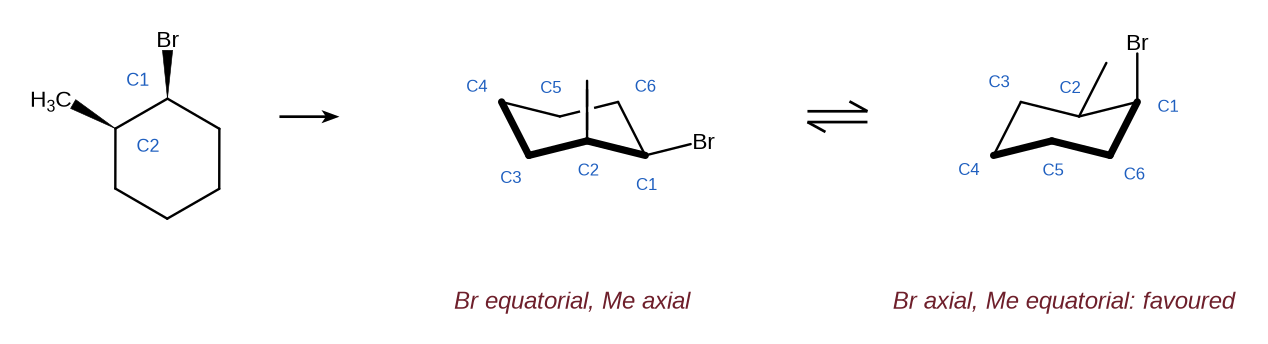
In the left chair Br is equatorial and the methyl axial. After the flip the bromine is axial and the methyl equatorial. The A-value of methyl (about 7 kJ/mol) is far bigger than that of bromine (about 2), so the chair with the methyl equatorial and the bromine axial wins, by roughly 7 − 2 = 5 kJ/mol.
Example 2: trans-1-methyl-2-phenylcyclohexane
Methyl up on C1 and phenyl down on C2 make the ring 1,2-trans: either both equatorial or both axial (Figure 2).
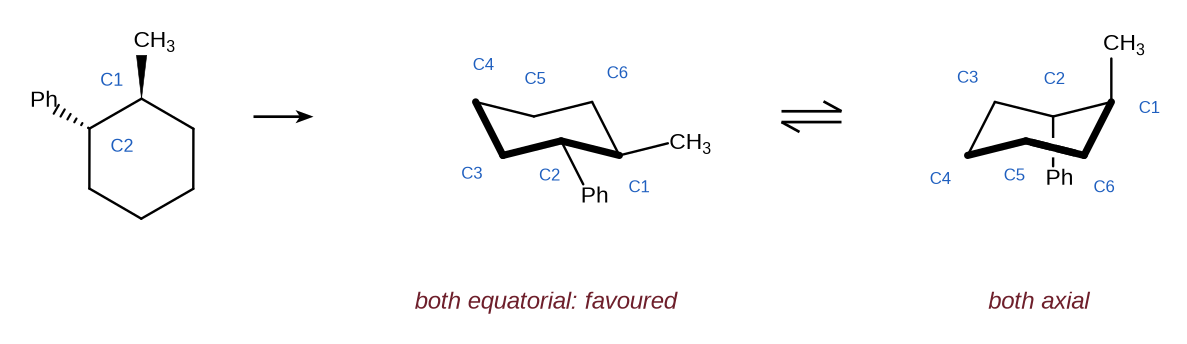
With two groups that both dislike the axial seat there is no contest. The diequatorial chair has nothing axial at all. The diaxial chair pays for both groups: adding the two A-values gives about 7 + 12 = 19 kJ/mol. In the diequatorial chair the two groups are neighbours and sit gauche to each other, which costs a few kJ/mol, so the true difference is a little less than 19. It is still large enough that the diaxial chair is a rarity.
Example 3: cis-1,3-dichlorocyclohexane
Both chlorines are up, on C1 and C3, so the ring is 1,3-cis: both equatorial or both axial (Figure 3).
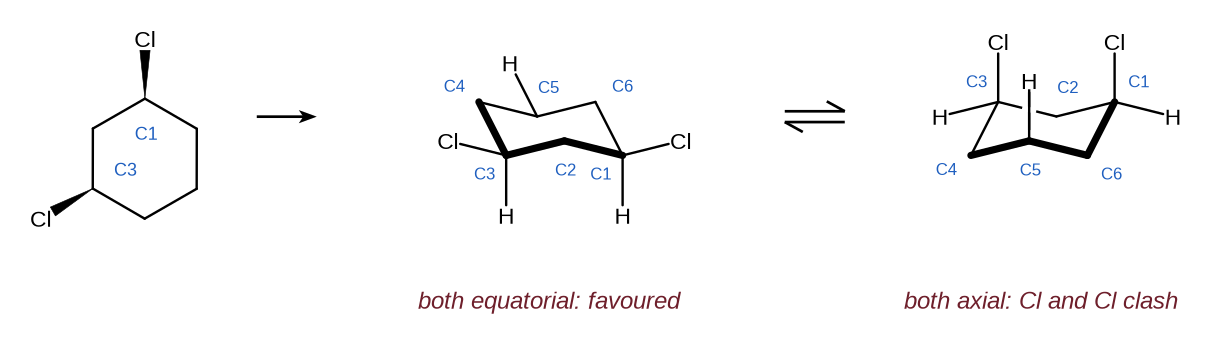
In the diaxial chair the two axial chlorines point up from carbons that are only two bonds apart, so they sit right next to each other, and each one also meets the axial hydrogen on C5. That is much worse than simply adding two small A-values, so the diequatorial chair is strongly favoured. A 1,3-diaxial clash between two groups costs more than the A-values predict.
Example 4: β-D-glucopyranose, all equatorial
Pyranose sugars such as glucose are chairs with five substituents, and the same method works (Figure 4). In the flat ring, a wedge is a group pointing up and a hash a group pointing down: OH on C1 and C3 up, OH on C2 and C4 down, CH₂OH on C5 up.
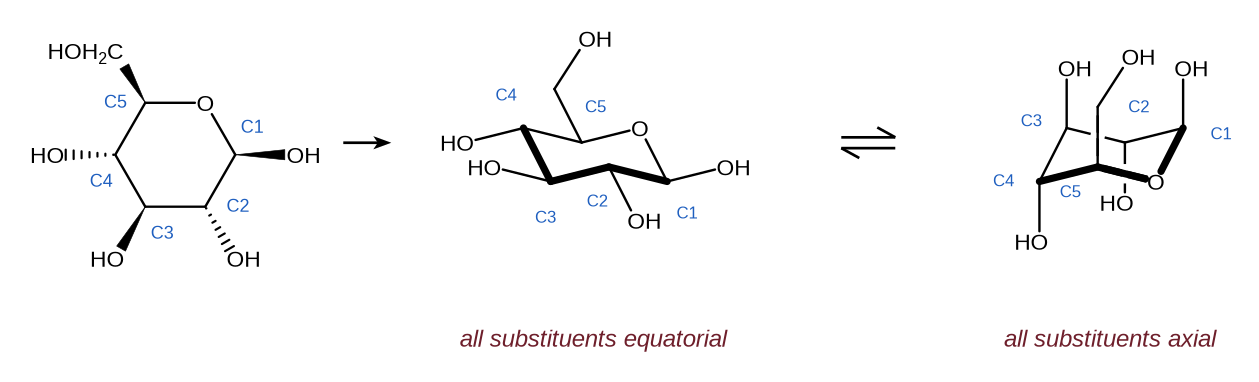
Put the ring in a chair with the ring oxygen at the back right and the result comes out of the table: every one of the five groups is equatorial. Flip it, and all five are axial, with every group meeting its 1,3-diaxial neighbours. That is why this sugar is so at home in the left chair, one reason (among others) why it is the most abundant sugar in nature.
Two groups on a chair. On every second carbon the axial bond points the other way. 1,2-cis and 1,4-cis give one axial, one equatorial; 1,3-cis gives both equatorial or both axial; trans reverses each. The chair with the larger group (the bigger A-value) equatorial wins; both axial is usually the worst.
Watch out. A ring flip never changes cis into trans. Cis and trans are about up and down, and a flip only swaps axial and equatorial. If your two chairs seem to disagree about cis and trans, you have drawn one of the groups on the wrong face.
More from Structure
What is the difference between configuration and conformation?
Two words that look like twins and are not. One test tells configuration and conformation apart: do you have to break a bond to get from one arrangement to the other?
How do you draw a Newman projection? Newman and sawhorse, side by side
Natta, sawhorse and Newman are three drawings of the same bond. Learn to jump between them without thinking, using 2,2-dimethylbutane and butane as the worked examples.
What are staggered, eclipsed, gauche and anti? Rotation around a single bond
Turn one single bond and the energy goes up and down like a wave. Staggered, eclipsed, gauche and anti explained with ethane, butane and 2,2-dimethylbutane.
Why is tert-butyl always equatorial? A-values explained
Cyclohexane flips between two chairs, and a tert-butyl group will spend almost all its time in one of them. Axial against equatorial, the A-value, and why size is not the whole story.