
 PossieChem
Why is phenol a million times more acidic than ethanol?
Phenol and ethanol both carry an O–H, yet phenol is a million times more acidic. And a nitro group on the ring changes the number again. Resonance, drawn out.
- What a pKa means (a small pKa is a strong acid)
- Resonance and curly arrows
- The conjugate base idea
Look at the two molecules in Figure 1. Each has an O–H group, and each oxygen carries one hydrogen. On the left the oxygen sits on an aromatic ring (phenol), on the right on an ethyl group (ethanol). You would not expect the ring to matter much: the proton leaves from the oxygen, and the oxygen looks the same in both.
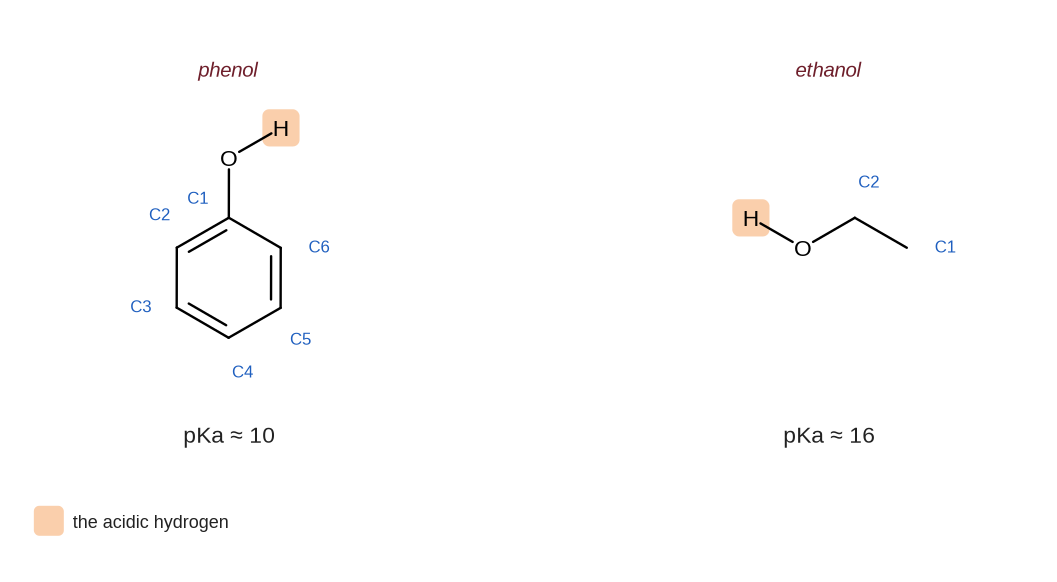
It does matter. The pKa of phenol is about 10, that of ethanol about 16. Six units, a factor of : phenol gives up its proton a million times more easily. Where does the million come from?
Step 1: the proton leaves, the oxygen keeps the pair
Figure 2 shows phenol giving its proton to water. The two arrows are the same ones every O–H acid uses: arrow 1 is a lone pair of the oxygen of water forming a bond to the hydrogen, arrow 2 is the O–H bond turning into a lone pair on the phenol oxygen. What is left is the phenolate ion.
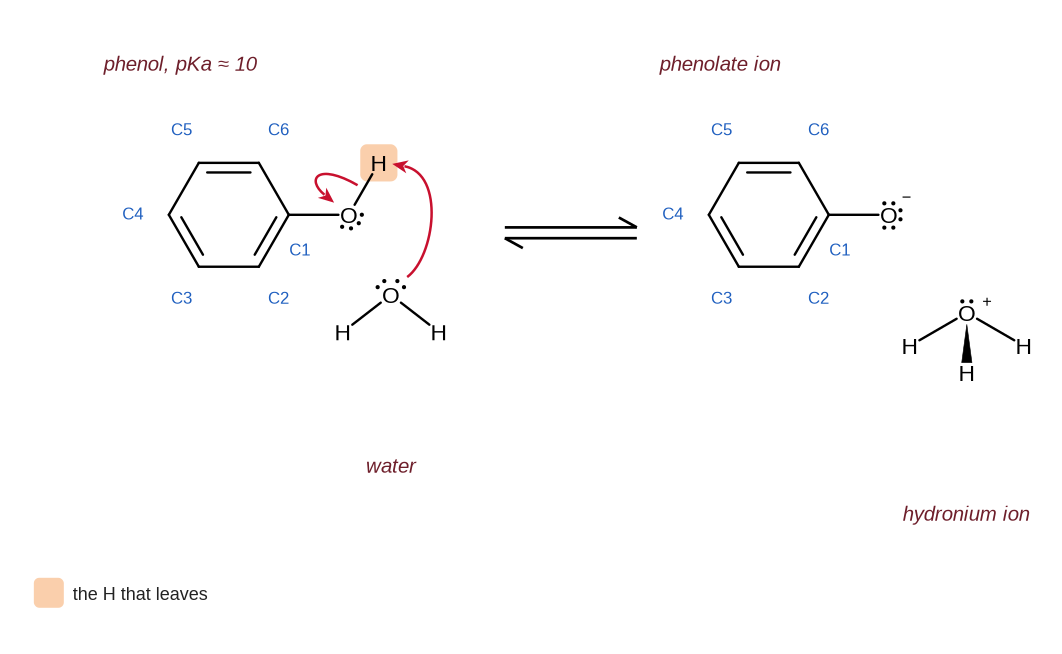
For ethanol the same two arrows give an alkoxide, with the charge stuck on one oxygen and nowhere to go. For phenol something else is possible, because the oxygen is bonded to a carbon that is part of a π system.
Step 2: the negative charge walks into the ring
A lone pair on a carbon-bound oxygen next to a C=C can move. Figure 3 follows it. Arrow 1: a lone pair of the oxygen forms a C1=O double bond. Arrow 2: the C1=C2 π bond moves to C2 and becomes a lone pair there. Now the charge sits on C2. Repeat the trick along the ring (the same two arrows, shifted by two atoms) and the charge reaches C4. The same moves also work towards C6.
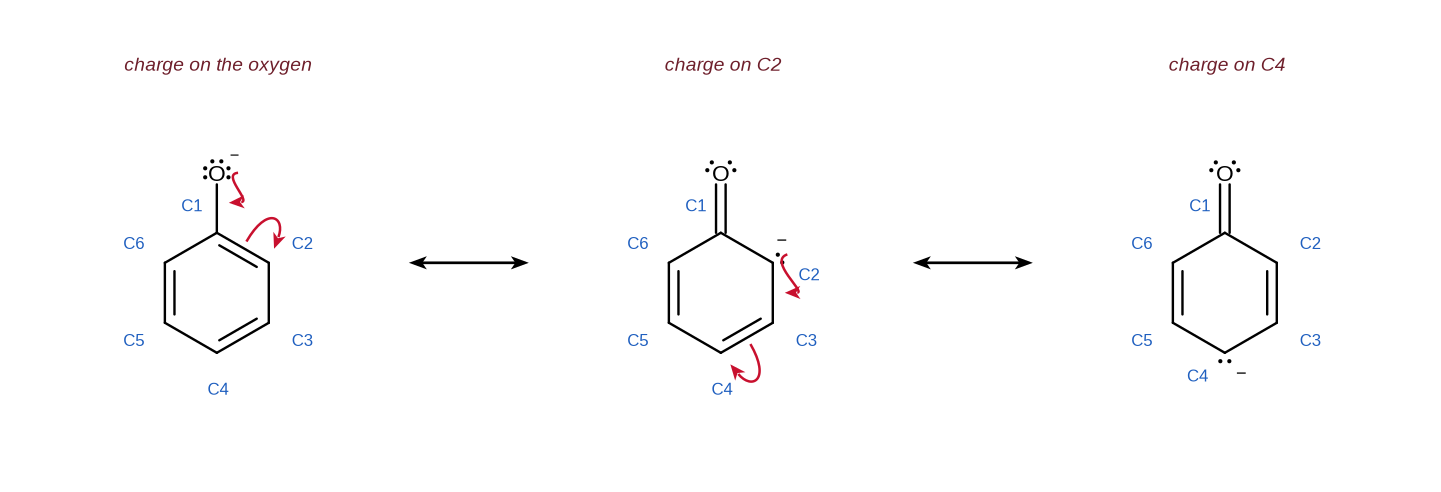
None of these drawings is the real ion. The real ion is one structure with the −1 shared over the oxygen and three ring carbons. A charge that is spread over four atoms is less concentrated and more comfortable than one on a single atom, so the phenolate ion is much more stable than that alkoxide, and phenol is the stronger acid. The oxygen of ethanol has no such way out.
Key idea. The more a conjugate base can spread its negative charge, the stronger the acid. Phenol (10) beats ethanol (16) because its anion can share the charge with C2, C4 and C6.
Step 3: a nitro group at C4 joins the party
Now put a nitro group on C4, the position where the charge arrives in Figure 3. This is 4-nitrophenol, and its pKa is 7.2: 2.8 units, a factor of about 600, more acidic than phenol. The nitro group does not just pull electrons through σ bonds as chlorine does: it takes the charge in.
Figure 4 follows the charge. The first three arrows are Figure 3 again: the oxygen lone pair forms the C1=O bond, and the π bonds shift until the charge sits on C4. Then arrow 4 sends the lone pair on C4 into the C4–N bond, making it a double bond, and arrow 5 pushes the N=O π bond onto an oxygen of the nitro group as a lone pair. The charge now sits on an oxygen of the nitro group, which is a good place for it: oxygen is electronegative and the charge is as far from the original oxygen as it can get.
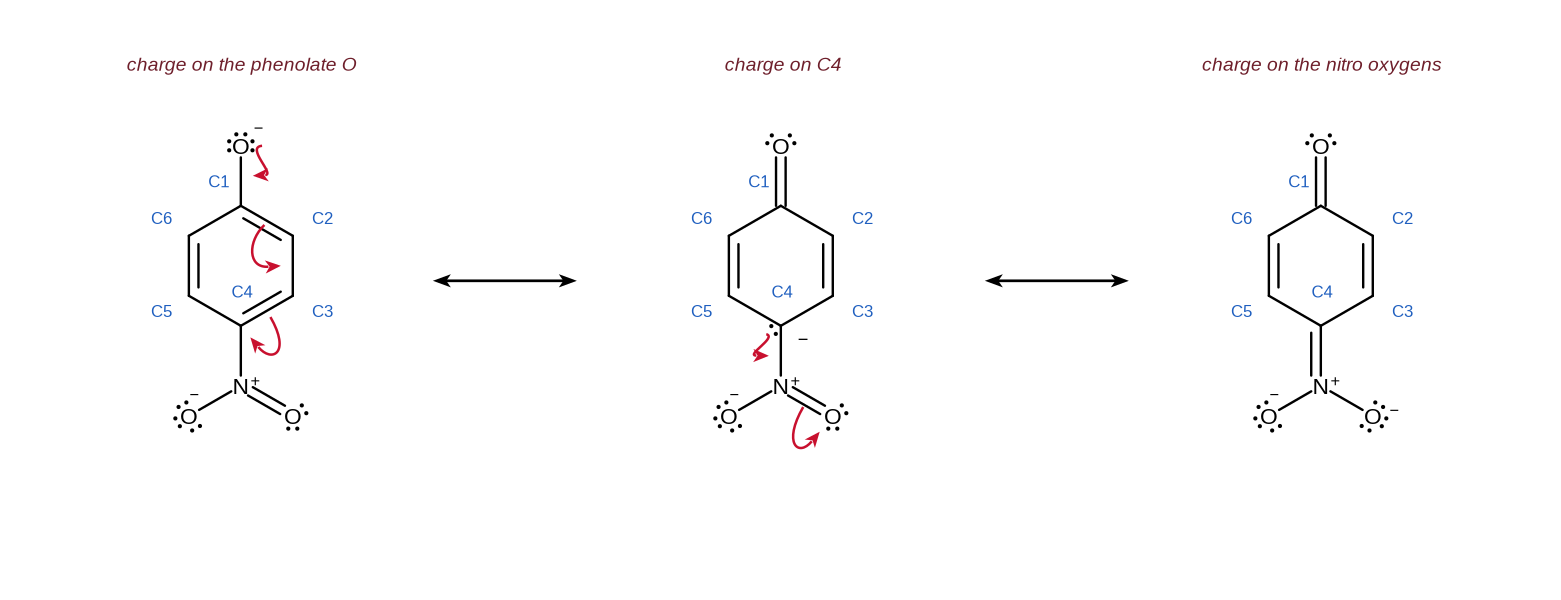
A nitro group on C3 (the meta position) cannot do this, because the charge never reaches C3: it only lands on C2, C4 and C6. The ortho and para positions are the ones that count.
Step 4: lining up five phenols
Figure 5 puts five phenols in order. 2,4-Dinitrophenol has two nitro groups, on C2 and C4, both at positions the charge reaches, and its pKa is 4.1: as acidic as a carboxylic acid. 4-Nitrophenol (7.2) has one. 3-Chlorophenol (9.1) has an electron-withdrawing chlorine on C3, where resonance cannot reach, so only induction is left, and it is a modest effect. Phenol itself is 10.0. 2-Methylphenol (10.3) has an electron-donating methyl group on C2 that pushes electron density into the ring, which makes the charge slightly less comfortable and the acid slightly weaker.
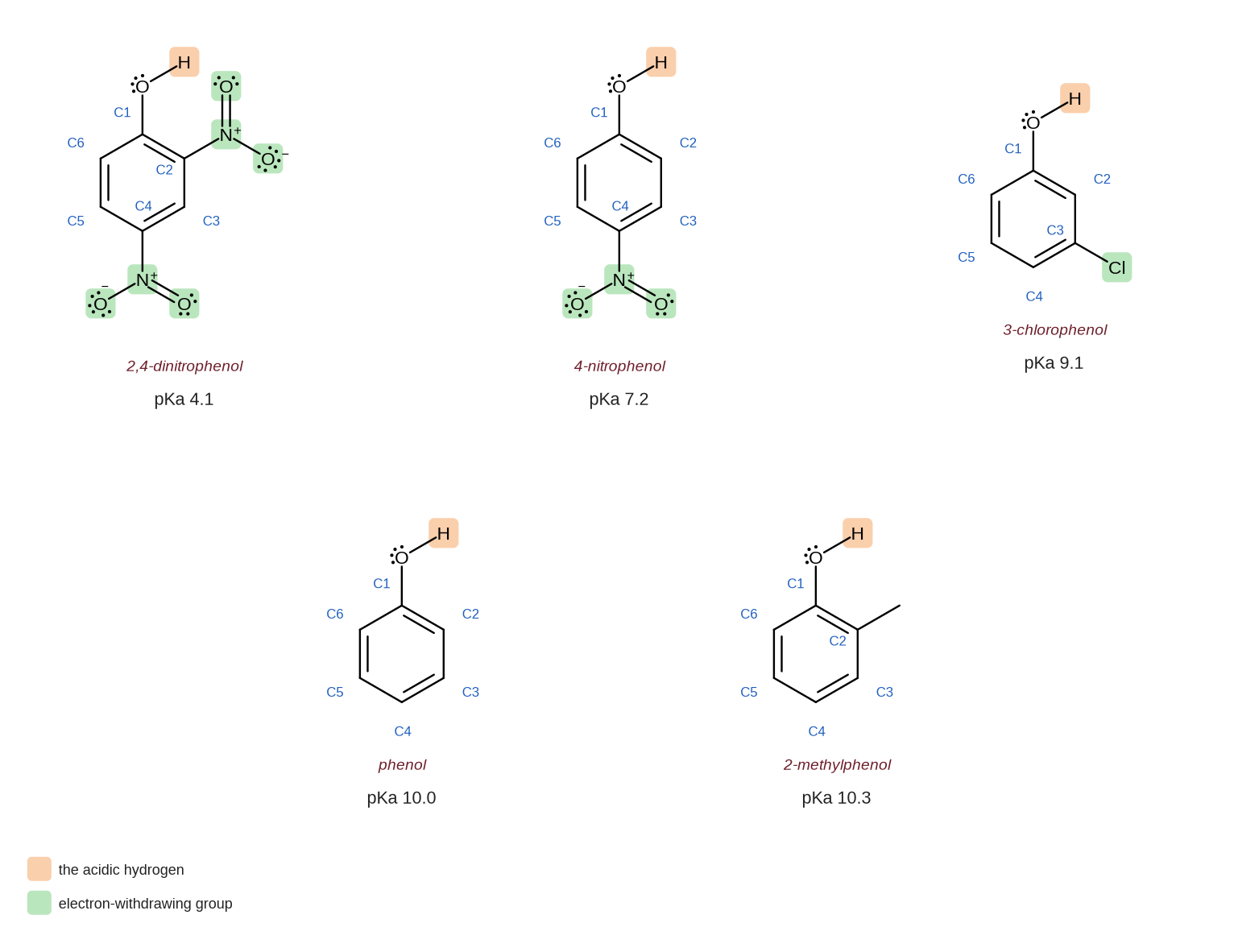
Watch out. Where the group sits matters as much as what it is. A nitro group on C4 or C2 stabilises the phenolate by resonance, a big effect. A group on C3 can only pull through the σ bonds, a small one that fades with distance. When two substituents are compared, ask first whether the charge can reach them.
More from Structure
What does a pKa tell you? Acid strength from one number
One small number says how hard an acid pushes its proton away, and with it you can tell which hydrogen in a molecule leaves first. Here is how to read it.
Which way does an acid–base reaction go? Predict it with pKa
Put phenol and pyridine in a flask and ask which way the proton moves. One subtraction of two pKa values gives the direction and how far it goes.
Why is acetic acid so much more acidic than ethanol?
Both lose a proton from an O–H bond, yet acetic acid is about a hundred billion times more acidic than ethanol. The reason is where the leftover charge can sit.
Why is HI a stronger acid than HF, though F is more electronegative?
Fluorine pulls electrons harder than iodine, so H–F should be the strongest of the hydrogen halides. It is the weakest. The trend turns around when you go down a group.